
Indigenous-Led Grizzly Bear Tours in the Great Bear Rainforest
The Great Bear Rainforest holds a presence that few places on Earth can match. Ancient cedars rise from the mist. Rivers carve through valleys shaped by millennia of salmon runs. And here, in the traditional territory of the Musg̱a̱makw Dzawada̱’enux̱w nation, grizzly bears move through the landscape with the same authority they have held for generations.
At Sea Wolf Adventures, we offer Indigenous-led grizzly bear tours in the Great Bear Rainforest that go beyond wildlife viewing. Our tours are grounded in the knowledge systems and stewardship practices of the Kwakwa̱ka̱’wakw people—knowledge earned over thousands of years of living in relationship with this territory. We guide you not just to see bears, but to understand them as our neighbors, our teachers, and our responsibility.
What Makes Indigenous-Led Grizzly Bear Tours Different
Indigenous-led grizzly bear tours in the Great Bear Rainforest are fundamentally different from standard wildlife excursions. When we guide you, you’re not simply observing animals from a distance. You’re learning how the Kwakwa̱ka̱’wakw understand the grizzly bear—its behavior, its role in the ecosystem, and the ancestral protocols that govern our interaction with it.
The grizzly bear (Ursus arctos horribilis) is not incidental to our territory. It is woven into our stories, our seasonal rounds, and our understanding of balance in the natural world. Our guides, who are members of the Musg̱a̱makw Dzawada̱’enux̱w nation, carry this knowledge forward. They know where bears gather during late summer and autumn, when salmon runs fill the rivers of Knight Inlet and Kingcome Inlet. They understand the signs—the turned-over stones, the stripped berry bushes, the prints in the mud—that tell the bear’s story.
This is what Indigenous-led grizzly bear tours offer: perspective grounded in place, guided by people whose families have stewarded this rainforest for generations.
Where Bears and Rivers Meet: Understanding the Great Bear Rainforest
The Great Bear Rainforest stretches across the central coast of British Columbia, a landscape of temperate old-growth forest, coastal waterways, and salmon-bearing rivers. It is one of the largest intact temperate rainforests in the world, and it is home to a robust population of grizzly bears who depend on the annual salmon migrations.
Our Indigenous-led grizzly bear tours operate from Northern Vancouver Island, traveling by boat into the heart of this territory. We journey through waters that have carried the canoes of our ancestors, moving into river valleys where grizzly bears gather each year. The timing of our tours follows the salmon season—late summer through fall, when bears are most active as they fish and forage in preparation for winter.
The landscape you’ll witness during these tours tells a story of ecological resilience. The rainforest’s productivity depends on the salmon runs, which in turn depend on healthy rivers and ocean ecosystems. The grizzly bears that fish these rivers are part of this cycle. When bears catch salmon and move through the forest, they distribute nutrients across a vast territory. Indigenous peoples of the Great Bear Rainforest have understood and participated in this cycle for millennia.
The Biology and Behavior of Grizzly Bears in the Great Bear Rainforest
Grizzly bears in the Great Bear Rainforest (Ursus arctos horribilis) are a distinct population, shaped by the resources and conditions of this specific ecosystem. These bears are primarily coastal and river-dependent, unlike their interior counterparts. They have evolved to exploit the massive salmon runs that occur each year, allowing them to achieve body sizes and densities that are remarkable among grizzly populations.
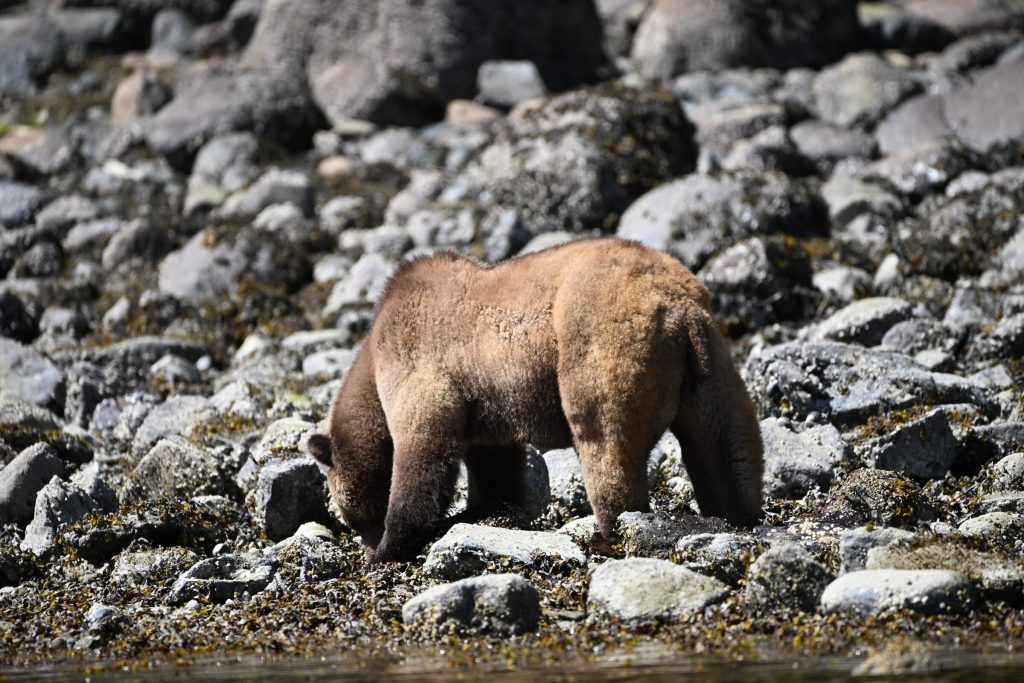
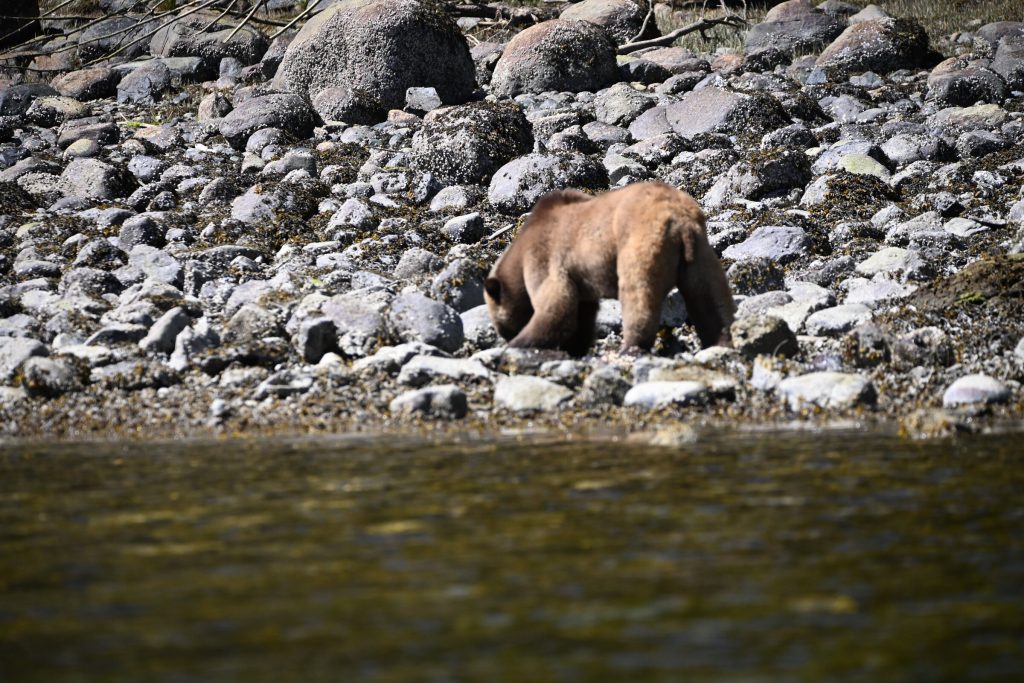
During late summer and autumn, when salmon move upstream to spawn, grizzly bears congregate at river mouths, falls, and shallow sections where they can intercept the fish. A single bear might catch dozens of salmon in a day during peak season. This abundance allows bears to be selective—they may eat only the brain and skin of a salmon, leaving the rest. This behavior, while appearing wasteful to the uninformed observer, is actually an energy optimization strategy. The brain and skin contain the highest concentrations of fat and protein relative to effort expended.
Our Indigenous-led grizzly bear tours in the Great Bear Rainforest position you to witness this behavior firsthand, while our guides explain the ecological logic underlying it. We observe bears at a respectful distance, following protocols that have been refined over generations of interaction with these animals.
Seasonal Timing: When to Experience Indigenous-Led Grizzly Bear Tours
The best season for Indigenous-led grizzly bear tours in the Great Bear Rainforest corresponds with the salmon run. This occurs primarily in late summer and continues through autumn, typically from mid-August through October. During this window, grizzly bears are most active and most likely to be encountered along river systems.
Early autumn represents peak season. Rivers are full with salmon, and bears are concentrated in productive fishing areas. The weather is generally stable, and visibility is good for both bear viewing and the journey by boat through the rainforest’s waterways.
The salmon themselves follow ancient migratory patterns. Humpback whales (gwa’yam in Kwak̕wala), porpoises (k’ulut’a), and other marine mammals also gather during this season, attracted by the same abundance of fish. This convergence of wildlife makes late summer and autumn the richest time to experience the Great Bear Rainforest’s ecosystem.
Indigenous Knowledge and Sustainable Stewardship
What distinguishes Indigenous-led grizzly bear tours in the Great Bear Rainforest is our commitment to sustainable stewardship. This is not a new commitment—it is an ancient one, renewed daily through the work of our people.
The Kwakwa̱ka̱’wakw principle of hiłamut—”only take what you need”—guides our approach to the rainforest and its inhabitants. We don’t view the grizzly bear as a resource to be maximized or exploited. Instead, we see the bear as a subject in its own right, worthy of respect and careful observation. When we guide you into bear territory, we do so with humility, recognizing that we are visitors in their landscape, granted access through careful behavior and ancestral protocol.
Our Indigenous-led grizzly bear tours follow strict guidelines to minimize disturbance. We maintain appropriate distances. We move quietly and predictably. We read the bears’ body language and respond by withdrawing if we sense stress. These practices are not imposed by external regulation—they flow from a relationship with the land that understands consequence and responsibility.
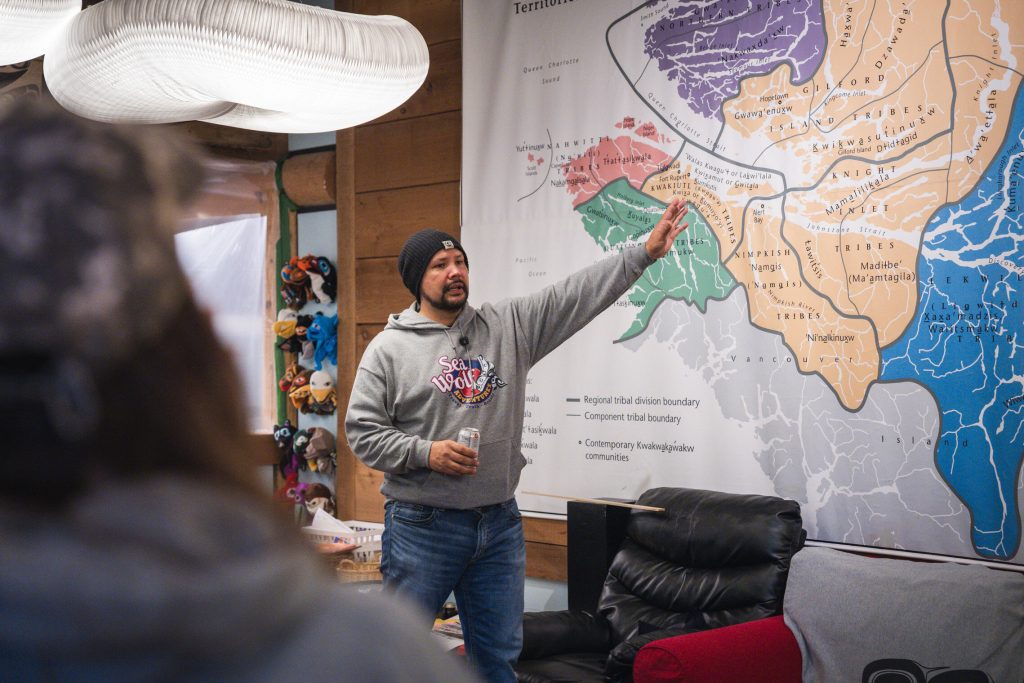
Sea Wolf Adventures is led by Mike Willie, a leader of the Musg̱a̱makw Dzawada̱’enux̱w nation, whose family has stewarded these territories for generations. This leadership ensures that every Indigenous-led grizzly bear tour in the Great Bear Rainforest reflects the values and knowledge of the people whose territory it is.
What to Expect During Your Tour
An Indigenous-led grizzly bear tour through the Great Bear Rainforest is an immersive experience. You will travel by comfortable boat through waterways that wind through old-growth forest. Your guides will point out details—the calls of kwikw (bald eagles), the presence of gwa’wina (ravens), the structure of the forest itself—that most visitors miss.
When grizzly bears are spotted, your guides will position the boat to offer optimal viewing while respecting the bears’ space and behavior. You’ll learn to read the signs of bear activity: fresh digging, scat, tracks, fishing sites. Your guides will explain the behavior you’re witnessing in real time—why a bear is fishing in this particular location, what the water conditions reveal about salmon behavior, how bears use their knowledge of the territory to maximize feeding efficiency.
The experience is meditative and educational in equal measure. The rainforest itself becomes a teacher, and the grizzly bear becomes a window into understanding how this ecosystem functions.
Why Indigenous-Led Tours Matter for the Great Bear Rainforest
Indigenous-led grizzly bear tours in the Great Bear Rainforest represent more than tourism. They represent the continuation of Indigenous stewardship and the economic viability of conservation-based livelihoods for First Nations communities.
When you choose an Indigenous-led tour, you’re supporting a business owned and operated by the Kwakwa̱ka̱’wakw people. Revenue flows directly into community priorities: cultural education, environmental monitoring, youth engagement, and territorial stewardship. This economic model allows Indigenous communities to thrive while maintaining their territories in healthy condition.
The grizzly bears of the Great Bear Rainforest benefit when their habitat is protected and managed by the people who have the deepest knowledge of how to do so. Indigenous-led tourism creates economic incentives for conservation that align with Indigenous values and practices.
Plan Your Indigenous-Led Grizzly Bear Tour
Our Indigenous-led grizzly bear tours in the Great Bear Rainforest depart from Northern Vancouver Island, accessing the central coast where the richest bear viewing occurs. Tours operate during the salmon season—late summer through autumn—when conditions are optimal and bear activity is at its peak.
We welcome travelers who approach the experience with respect and genuine interest in learning. Whether you’re a wildlife enthusiast, a photographer seeking to document bears in their natural behavior, or someone drawn to deeper understanding of Indigenous territories and knowledge systems, there is a place for you on our tours.
The Great Bear Rainforest and its grizzly bears are waiting. We invite you to experience them as we do—with attention, humility, and the knowledge that you are learning from a place and a people whose relationship with this landscape runs deeper than any of us.